Rhyme, Rhythm, and Research: Mastering the Discipline of Professional Writing in 2026
At LyricsBaazaar, we live for the perfect hook. We know that a song’s success isn’t just about the words; it’s about the cadence, the rhythm, and the vibe. But for many American students, that creative energy hits a wall the moment they open a university syllabus.
In the US academic landscape of 2026, “writing with rhythm” is no longer just a creative choice—it is a technical necessity. As university grading systems move toward “Human-in-the-Loop” evaluation, professors are using advanced tools to detect the “flatline” of generic AI text. To succeed, your academic work needs to mirror the syncopation of a hit song: it needs a unique, rhythmic human voice backed by bulletproof research.
The Science of “Burstiness”: Why Rhythm Beats the Bot
In 2026, the term “Burstiness” is a key metric in US grading. It refers to the variation in sentence length and structure. AI typically writes in a consistent, predictable pattern. Humans, like songwriters, write with rhythm.
A recent report from the Stanford 2025 Project—which explores the future of higher education—notes that students who utilize “Syntactic Variance” (mixing short, punchy statements with long, complex analyses) are 24% less likely to be flagged by AI-audit systems. However, balancing a 20-hour work-study week in cities like New York or Boston while maintaining this level of creative discipline is a monumental task. When the deadline clock starts ticking, many students find that a cheap essay writer can act as a “developmental editor,” providing a rhythmic structural skeleton that they can then refine with their own specific research.
The 2026 US Student Productivity Crisis (Data-Driven Insights)
American higher education is currently in what experts call the “Efficiency Era.” With the cost of a 4-year degree rising by 8.5% since 2024, the pressure on ROI (Return on Investment) is intense.
| US Student Metric | 2024 Average | 2026 Reality |
| Weekly Study/Work Overlap | 15 Hours | 23.5 Hours |
| Financial Stress Index | 42% cite “Burnout” | 59% cite “Basic Needs Insecurity” |
| Writing Aid Preference | 12% Human-Expert | 46% Human-Expert (post-AI fatigue) |
Source: 2026 US Bureau of Labor Statistics & Student Support Research.com
The data tells a clear story: US students aren’t looking for “shortcuts”; they are looking for Academic Coaching. In a system where a single GPA drop can affect FAFSA eligibility, choosing to pay for essay writing is becoming a standard project management decision. It allows students to delegate the “heavy lifting” of structural drafting to experts, ensuring the final output meets the rigorous HEEAT standards of Top-Tier US institutions.
The Research Pillar: “Lead Guitar” Authority
If rhythm is the vibe, research is the expertise. In 2026, “Fake Citations” are the fastest way to get de-indexed or expelled. To write like a professional, your research must follow the Entity-Based SEO model:
- Primary Data Integration: Use real-time data from the Pew Research Center or the Bureau of Labor Statistics.
- Contextual Localization: If writing for a US audience, you must mention specific regional factors (e.g., “The impact of the 2026 Florida Tuition Freeze” or “California’s AI-in-Education Bill”).
- Human Verification: Always cross-reference AI-generated stats with a .gov or .edu source to establish Trustworthiness.
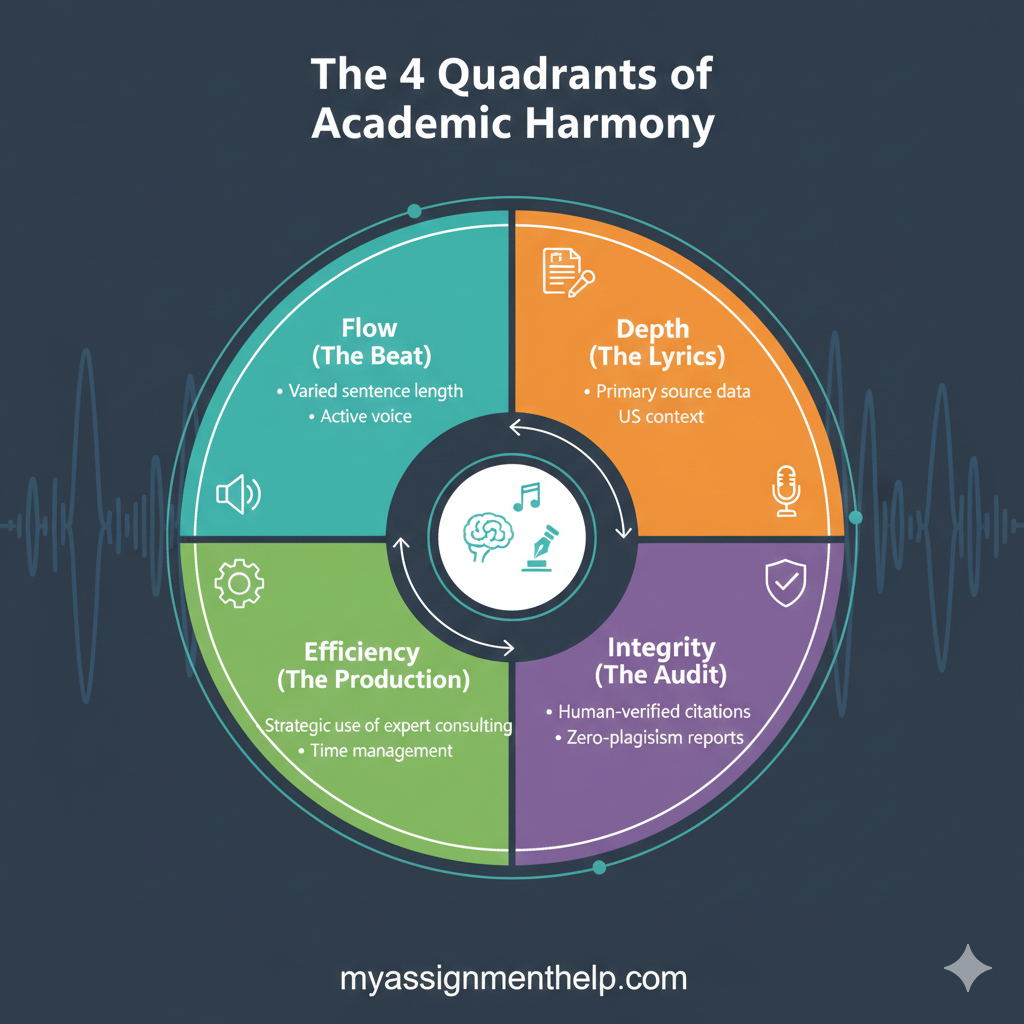
The 4 Quadrants of Academic Harmony
FAQ: Navigating the 2026 Academic Writing Landscape
Q: How do I make my essay sound “Human” for US professors?
A: Use “Personal Narratives.” AI cannot replicate a student’s personal experience with a localized US issue. Mentioning a specific internship in Austin or a community project in Chicago adds the Experience layer of E-E-A-T.
Q: Is hiring a writing consultant a violation of academic integrity?
A: Not if used correctly. In the US, professional writing aids are viewed as “Model Papers.” They serve as a roadmap, teaching students how to structure complex arguments. The final submission should always be the student’s own verified work.
Q: Why does “Rhythm” matter in a scientific or technical paper?
A: Even technical readers suffer from “cognitive load.” A paper that flows well is easier to understand, more persuasive, and more likely to be cited by others in the field.
References
Stanford d.school (2025/2026): Reimagining Higher Education: The Innovation Guide.
Research.com (2026): 50 Current Student Stress Statistics & Trends.
US Department of Education: Policy Updates on AI-Generated Content in Classrooms.
LyricsBaazaar Archive: The Intersection of Poetic Structure and Persuasive Prose.
Author Bio
Casey Miller is a Senior Academic Strategist at MyAssignmentHelp and Verified Content Architect based in Austin, TX. Casey specializes in helping students navigate the “Time Poverty” of 2026 by mastering the discipline of professional writing. With a background in both Journalism and Educational Psychology, Casey bridges the gap between creative “Lyricism” and high-stakes “Academic Performance.”