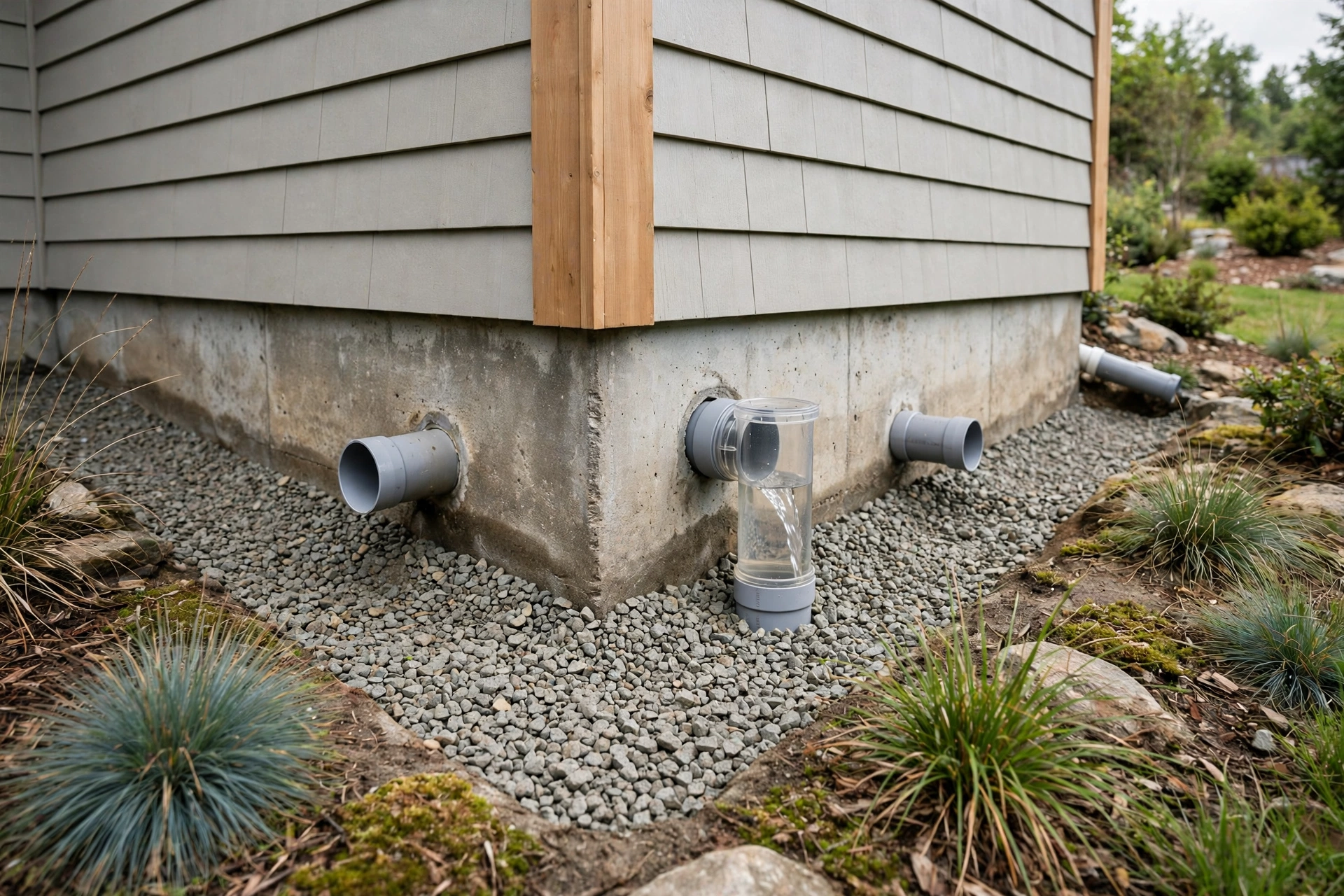
Innovative Residential Foundation Drainage Outlets That Simplify Long-Term Maintenance and Water Flow Monitoring
A foundation drain can be perfectly installed and still fail, because the part that matters most is the part you almost never look at: the outlet. The perforated pipe around the footing collects groundwater and carries it away, but it can only do that job if the water has somewhere to go. When the outlet clogs, collapses, or sits underwater, the whole system backs up silently, and the first symptom is usually dampness on a basement wall or water seeping through the joint where the wall meets the floor.
The short answer is that a good foundation drainage outlet is visible, protected, and easy to check: it discharges to daylight on a slope, or to a pop-up emitter, or into a dry well, with a screen or grate keeping debris out and a cleanout nearby for testing flow. Modern outlet designs add simple monitoring, such as a marked flow gauge or a small observation well, so a homeowner can confirm the system is working in thirty seconds after a rainstorm.
Why the Outlet Decides Whether a Foundation Drain Works at All
Homeowners spend a lot of attention on the buried pipe and almost none on the outlet, which is backwards. The pipe is a passive channel; the outlet is the control point. Every gallon the drain collects must pass through that one opening, so a single crushed end, a nest of leaves, or a few inches of settled soil can throttle the entire system. A drain with a blocked outlet is not a drain at all, it is a buried reservoir that fills up and pushes water back against the foundation it was meant to protect.
Outlets also fail in slow motion. Soil creeps over a daylight outlet year by year. A pop-up emitter gets buried under mulch. A dry well fills with silt. None of these produce a dramatic event, they just quietly reduce capacity until one heavy storm overwhelms the system. That is why the best outlet designs are the ones a homeowner can see and reach without tools, because a visible outlet gets checked and a hidden one gets forgotten.
How Daylight Outlets Carry Foundation Water Away From the House
A daylight outlet is the simplest and most reliable discharge: the drain pipe runs downhill and ends in open air, usually on a slope below the house, where water flows out and away by gravity. No pump, no moving parts, nothing to power. The key requirement is fall. The pipe needs a steady downward slope of at least one inch in eight feet, and the outlet itself must sit above the level where water can pond around it, because an outlet that sits in a puddle cannot drain.
The exit point deserves real protection. A rodent screen or a slotted grate keeps animals and leaves out while letting water pass freely. A small splash pad or a bed of stone below the outlet stops the discharge from cutting a channel into the slope. And the ground around the outlet should fall away from the pipe, so the water it releases keeps moving downhill instead of soaking back toward the foundation it just left.
Reading Your Site Slope Before Choosing an Outlet Location
Not every lot can daylight a foundation drain, and the decision starts with the land, not the pipe. Walk the property after rain and watch where water already goes. If the ground falls away from the house on at least one side, a daylight outlet on that side is the natural answer. If the lot is flat or slopes toward the house, the outlet needs help, either a sump pump that lifts water to a discharge point, or a dry well that stores it until the soil absorbs it.
Find the lowest edge of the lot and check whether a gravity pipe can reach it
Measure the fall from the footing to the proposed outlet before digging
Look for spots where water already ponds, and keep the outlet away from them
Confirm the discharge will not flood a neighbour’s lot or a public walkway
Local rules matter here too. Many areas restrict where foundation water may discharge, and some require it to go to a storm drain or a swale rather than across a property line. A quick check with the local building department before trenching saves the cost of moving an outlet that was built in the wrong place.
Pop-Up Emitters, Open Outfalls, and Dry Wells Compared
When a daylight slope is not available, three outlet types cover most homes. A pop-up emitter is a spring-loaded cap at the end of a buried pipe that lifts when water pressure builds and closes flat when the flow stops, which keeps the lawn tidy and the pipe sealed against debris. An open outfall is a simple exposed pipe end, cheap and easy to inspect, but it needs a grate and a splash pad. A dry well is a buried gravel or plastic chamber that stores water and lets it soak away slowly, useful on flat lots with permeable soil.
| Outlet type | Best for | Maintenance demand |
|---|---|---|
| Daylight outfall | Sloped lots with gravity fall | Low: clear the grate seasonally |
| Pop-up emitter | Flat lawns where an open pipe is unwanted | Medium: check the cap moves freely |
| Dry well | Flat lots with permeable soil | Medium: flush silt every few years |
| Sump pump discharge | Lots that slope toward the house | Higher: test pump, float, and alarm |
No single type wins everywhere. A pop-up emitter looks neat but can stick shut if silt builds under the cap, so it needs a seasonal press test. A dry well works beautifully until the soil around it clogs with fine silt, which is why a fabric wrap and a cleanout matter. The right choice is the one that matches the soil, the slope, and the amount of attention the homeowner is realistically going to give it.
Animal Guards, Screens, and Grates That Keep Outlets Open
An open pipe end is an invitation. Rodents nest in it, frogs shelter in it, and leaves blow into it, and each one narrows the opening a little more. A stainless mesh screen or a hinged grate at the outlet stops most of that without restricting flow. The screen should be coarse enough that a heavy flow pushes debris through rather than plastering it across the mesh, and it should be removable by hand, because a guard that needs tools to clean is a guard that never gets cleaned.
The grate also needs a little thought about what sits below it. Water leaving a foundation drain carries fine silt, and that silt settles right where the water slows down, which is at the outlet. A shallow stone bed or a short length of solid pipe at the exit keeps the silt from building a dam at the mouth of the drain. Check the outlet after the first big storm of the season, when the heaviest sediment load arrives, and clear whatever has collected before it hardens.
Watching Flow After Rain: A Simple Monitoring Routine
Monitoring a foundation outlet does not need sensors or an app, though both exist. The basic routine is a two-minute walk after rain: stand at the outlet while the ground is still wet and watch. A healthy system shows a steady stream that tapers off within a few hours of the rain stopping. A weak trickle during a downpour, or no flow at all while the soil is saturated, means water is backing up somewhere upstream.
Watch the outlet during rain and note whether flow starts promptly
Time how long flow continues after the rain stops
Compare flow between the two sides of the house after the same storm
Write down the date and the result so a slow decline becomes visible
A written record turns vague worry into useful evidence. If flow after a one-inch rain was strong last year and weak this year, something has changed inside the pipe, and a camera inspection is worth the cost. Homeowners who want more precision can add a small observation well, which is a vertical pipe beside the drain that shows the water level in the gravel bed, or a simple flow marker at the outlet that makes changes in discharge easy to spot.
Clearing Silt and Roots Without Digging Up the Line
When flow drops, the first step is the least invasive one. Open the cleanout nearest the outlet and run a garden hose into the line at moderate pressure. In many cases the flow of water alone carries loose silt out through the outlet, and the discharge runs cloudy for a minute before clearing. If that does not restore flow, a plumber’s snake or a hydro-jet can scour the pipe walls, and a camera inspection will show whether roots have entered through a joint or a crack.
Roots deserve respect. A fine root hair entering a drain joint can grow into a dense mat in a single season, and pulling it out without fixing the entry point just invites it back. Where roots are the problem, the lasting fix is to seal or replace the damaged section and, if possible, to move the offending tree or to install a root barrier between the tree and the drain line. Chemical root killers can help in the short term, but they do not repair the opening the roots used.
When an Outlet Needs Relocating Instead of Repairing
Some outlets cannot be saved where they are. An outlet that discharges into a low spot that floods every spring will always struggle, because the water it releases has nowhere to go. An outlet buried under a new driveway, patio, or extension has lost its access and its fall. In these cases the honest fix is to move the outlet, not to keep clearing a pipe that fights the landscape.
Relocating an outlet means re-establishing fall from the footing to the new discharge point, which sometimes requires a sump pump where gravity alone cannot do the job. It is more work than a cleaning, but it is cheaper than the water damage a failed outlet eventually causes. If the house is getting an extension or a new patio anyway, that is the moment to reroute the outlet, while the ground is already open and the machinery is already on site.
Connecting Sump Discharge and Foundation Outlets Into One Plan
Many homes have two systems that never meet: a foundation drain that daylights on one side and a sump pump that discharges on the other. Connecting them into one plan makes both easier to maintain. The sump discharge can join the foundation outlet line through a check valve that stops water flowing back into the pit, and a single shared outfall means one place to inspect instead of two. The shared route needs to be sized for the combined peak flow, and the pump discharge should enter the gravity line downstream of the foundation drain, so a pump cycle cannot push water back toward the footing.
A shared plan also simplifies winter care. In cold climates, a sump discharge that ends at the surface can freeze and back up into the pit, so the line needs a freeze-resistant termination or a buried discharge below the frost line. A gravity foundation outlet rarely freezes if it keeps flowing, because moving water resists ice, but a shallow pop-up emitter can freeze shut in a cold snap. Knowing which parts of the combined system are vulnerable lets the homeowner check the right spots before the first hard freeze.
Foundation Drainage Outlet Questions Answered for Homeowners
How do I know if my foundation drain outlet is working?
Watch it during or just after rain. A working outlet shows a steady flow that starts soon after the rain begins and tapers off within a few hours. No flow during a heavy storm while the soil is saturated is a warning sign. A hose test through the nearest cleanout gives the same answer on a dry day.
What is a daylight outlet, and does my house have one?
A daylight outlet is a drain pipe that ends in open air on a slope, letting water flow out by gravity. Walk the lowest edge of your lot and look for a pipe end, a grate, or a stone splash pad. If your lot is flat or slopes toward the house, you probably have a sump pump discharge or a dry well instead.
How often should a foundation drainage outlet be cleaned?
Check it at least twice a year, in spring and autumn, and after any storm that drops more than an inch of rain. Clear leaves and debris from the grate, make sure a pop-up emitter still lifts freely, and confirm the ground around the outlet still falls away from the pipe.
Can tree roots really block a foundation drain?
Yes, and they are one of the most common causes of slow foundation drains. Fine roots enter through joints or small cracks and grow into a mat that traps silt. A camera inspection confirms it. The lasting fix is to repair the damaged section and keep trees or root barriers at a safe distance from the line.
Should a sump pump and a foundation drain share one outlet?
They can, and it often simplifies maintenance, but the connection needs a check valve so pump water cannot flow back into the pit, and the shared outfall must be sized for the combined peak flow. A plumber or drainage contractor should size the shared route before the lines are joined.
Final Thoughts: Foundation Outlets That Keep Working Long After Installation Day
A foundation drain is only as good as its outlet, and the outlet is the easiest part of the system to protect. Choose a discharge that matches the slope and the soil, guard it against animals and debris, and give it two minutes of attention after the rain. Those small habits are what separate a drain that quietly protects a house for decades from one that fails silently and announces itself through a damp basement wall. The pipe underground does the heavy work, but the outlet is where the homeowner earns the return on it.